
Nuclear War or Civilizational War?

blog
Written By Azadeh Yousefi
17 September 2025

For the past six months, Israel and Iran have ceased military attacks against each other. Although the situation appears unstable, there is hope that a renewed “war of cities” will not afflict civilians. This has provided an opportunity to reflect on the reasons behind a conflict that has been anticipated for years. Does the dispute between Israel and Iran stem from Iran’s nuclear programs? Would the conflict between them come to an end if Iran did not possess the program or it were to halt its nuclear activities entirely? Or should the roots of their disagreements be sought in other factors?

Evidently, the conflict between Israel and the countries of West and South Asia and North Africa is rooted more deeply in the identity foundations of these societies than in political and military issues. Since the end of the WWII, the struggles in the region have been over “territorial identity” rather than the “lands”. As a symbol of Western civilization in this part of the world, Israel has made considerable efforts to carve out a place for itself. And although it has sometimes succeeded, through war or dialogue, in aligning certain governments with itself and rendering others indifferent, it has nonetheless failed to find a stronghold among the peoples of various societies.

The Iranian society’s animosity towards this Western symbol dates back to the Pahlavi era. Despite the Pahlavi government’s diplomatic relations with Israel, memoirs left by policymakers of the time reveal the extent to which the government was cautious of public reactions to expanding relations with Israel.

With the victory of the Islamic Revolution in Iran, a new discourse emerged in the region that emphasized Eastern civilization and identity in contrast to what was labeled as Western colonialism and imperialism. In this new context, Israel was once again perceived as a symbol of the imposition of Western policies upon the nations of the East. In the post-Cold War era, Israel identified itself more with the Global North and alongside Western powers, rather than being defined within the Global South. These cultural and identity differences among the peoples of the WANA region have repeatedly led to wars in which Israel has been a party. Accordingly, it can be argued that while Israeli leaders might believe that initiating wars and attacking countries’ nuclear facilities can provide them with physical security, they have no doubt that identity and existential security will never be achieved through these means.

During the 12 days war, despite the stances taken by certain governments, numerous academics in various countries have sent messages and expressed sympathy and solidarity with the Iranian people, which well demonstrate the direction of global public opinion regarding the conflict. However, what demands greater attention is that many of the messages received from academics within our shared civilizational sphere—from Istanbul to Islamabad and New Delhi, and from Astana and Tashkent to Doha—have emphasized a number of key points: Firstly, they have expressed prayers for the safety and victory of the Iranian people. Secondly, they have stressed that they are constantly following the news and advised us to leave large cities for safer places. Some even kindly offered to host Iranian friends in their countries and homes should the war continue. And thirdly, in several messages, particularly from countries within the Nowruz cultural sphere, it was explicitly stated that they support Iran as a symbol of a civilizational identity to which they themselves belong.

Poetry and literature form an important part of the culture within our civilizational sphere. In recent months, many poems from academic friends in various countries of the region have reached us. I share one here as an instance, penned by an Afghan professor residing in Europe:

Tehran is a wounded lady,

Kabul’s sister city.

A bloody poem

In a two-and-a-half-millennium-old divan of civilization,

And a tale of struggle and patience

In the Shahnameh.

Tehran

Is the Cyrus Cylinder,

Blood-stained in the clutches of the demon of war,

And Persepolis,

Anxiously gazing towards tomorrow.

Tehran is our heart,

Beating from Lahore to Kabul,

From Dushanbe to Samarkand,

From Bukhara to Balkh,

And from Herat to Isfahan.

Tehran is our soul.

In this poem, as in many other empathetic messages that have reached our universities to date, Israel’s attack on Iran has been portrayed not as a war over nuclear issues, nor as a conflict over ideological or religious matters, but as a war between civilizations. The United States and its European allies’ support for Israel has also strengthened the belief among academics in the region that they need greater convergence with one another to preserve their cultural and civilizational foundations.

In this situation, it seems that we, as academics in different countries, need to have a fresh identification and discussion of our shared cultural and identity values within the framework of the ancient civilizations of our lands. Moreover, we can consider pathways for dialogue with other civilizations to establish lasting peace and security. Should we adopt more civilized methods of interaction, including dialogue, diplomacy, and the recognition of differences, civilizational conflicts can be prevented from escalating into war.

In the 1990s, when Huntington proposed the idea of the clash of civilizations, amidst various criticisms from around the world, Seyyed Mohammad Khatami, then President of Iran, put forth the initiative for a “Dialogue among Civilizations” at the United Nations. This laid the groundwork for 2001 to be designated as the Year of Dialogue Among Civilizations. It seems that the path to stability in the region is to return to that idea.


Author: Mandana Tishehyar – Faculty Member, Department of Asian Studies, ECO College, Allameh Tabataba’i University, Tehran, Iran

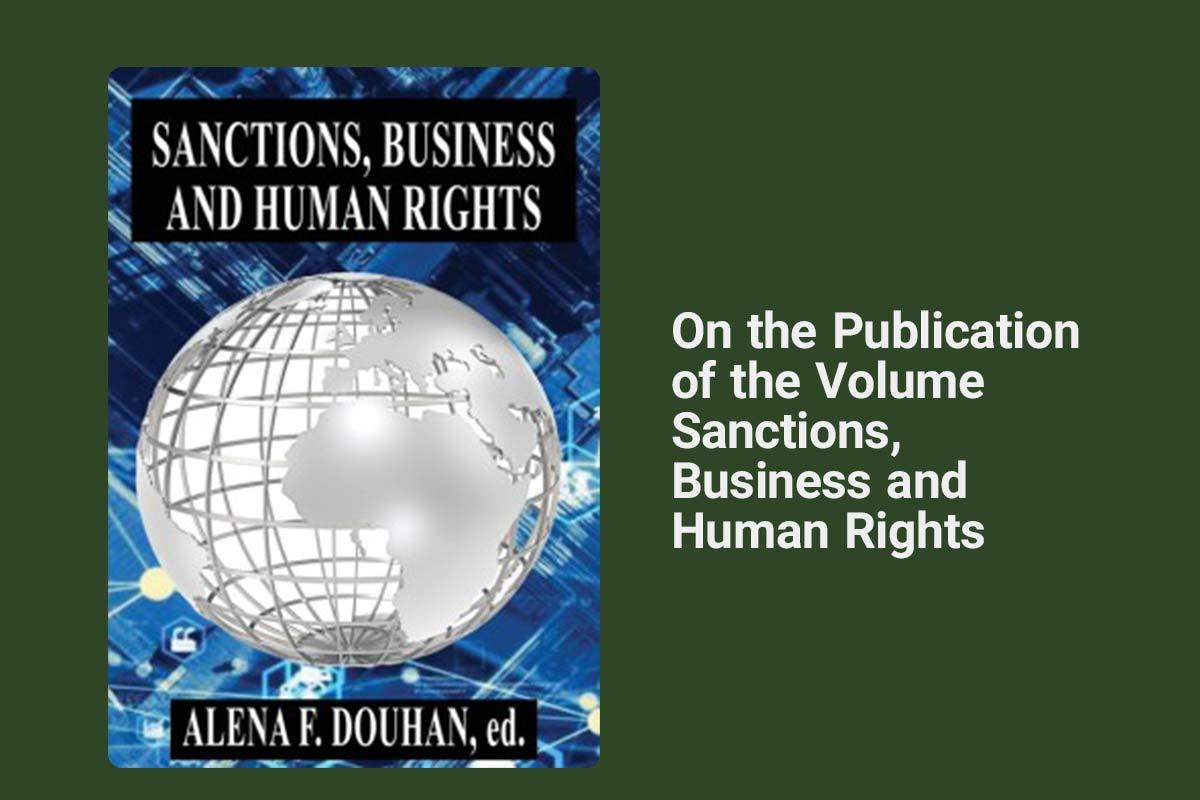
On the Publication of “Sanctions, Business and Human Rights”

On the Publication of “Sanctions, Business and Human Rights”


This post presents a shortened version of the remarks delivered on 15 September 2025 at a side event of the 60th Session of the UN Human Rights Council in Geneva, hosted by the Permanent Mission of the Republic of Belarus.

Traditionally, in international law, states and intergovernmental organizations have been regarded as the principal subjects, vested with rights and obligations. This, of course, meant that international legal duties were not directly imposed on non-state actors, since they were not the lawmakers of the system. Non-state entities could only benefit from rights conferred upon them by international law, but they were not generally burdened with obligations. This is why we speak so often about human rights in international law, but we rarely, hear about human obligations. Some scholars have indeed explored the issue (see e.g.: here), but overall, individual obligations are far more firmly anchored in domestic legal systems than in treaties or customary international law.

Corporations—especially multinational corporations—have long benefited from this asymmetry. For example, in the field of international investment law, and particularly in bilateral investment treaties, foreign investors and companies have enjoyed extensive protections, often without assuming any corresponding obligations. As a result, when investing in poor countries, many corporations have shown disregard for human rights, labor standards, and environmental protections. Sadly, their track record includes numerous violations in all these areas. (See e.g.: here)

This imbalance—between the rights and protections granted to corporations on one hand, and the absence of binding obligations on the other—combined with the troubling record of certain corporations, has sparked an ongoing debate among international legal scholars. For several decades now, there has been a growing movement to establish binding obligations for business enterprises under international law. Initially, led largely by scholars from developing countries, the concept of corporate social responsibility emerged, placing moral—rather than legal—duties on corporations (see: here). The United Nations joined this discourse through the launch of the Global Compact, a platform enabling companies to voluntarily commit themselves to respect human rights, labor standards, and environmental protections. (here)

Building on this momentum, John Ruggie, as the UN Secretary-General’s Special Representative, introduced the UN Guiding Principles on Business and Human Rights (here). His aim was to lend a quasi-legal dimension to the otherwise voluntary notion of corporate social responsibility. The “Ruggie Principles” received wide recognition and laid the groundwork for the Human Rights Council’s establishment of a working group tasked with drafting a binding treaty—a process that continues today.

While positive, enforceable obligations are still not directly imposed on corporations, there is now a growing consensus that corporations must at least accept negative obligations: they must not engage in actions that result in violations of human rights, labor rights, or environmental protections.

Of course, such a general principle requires more detailed elaboration. The Human Rights Council’s working group has taken important steps in this regard, relying on the well-established principle of due diligence. At its core, due diligence reflects the simple idea that no person or entity may pursue its own goals or exercise its rights in a way that harms the rights of others. (See: here)

This principle is enshrined in virtually all national legal systems, and more recently, several states—particularly in Europe—have incorporated it into their commercial laws as binding duties on companies. (See: here) At the national level, lawsuits have been filed against corporations for failing to uphold this obligation, the most notable being the high-profile case against Shell in Dutch courts (see: here). Similarly, in investment disputes between host states and foreign investors, arbitral tribunals are increasingly recognizing investor obligations based on the principle of due diligence. (See: here)

Having these developments in mind, Professor Alena Douhan, the UN Special Rapporteur on the negative impact of unilateral coercive measures, has made an invaluable contribution by linking the ongoing work on corporate due diligence with the pressing issue of unilateral sanctions. This is both a strategic and realistic approach. In practice, the enforcement of unilateral sanctions depends heavily on the conduct of private companies. The very trade and financial transactions that sanctioning states aim to restrict are carried out through corporations. If companies, relying on their due diligence obligations, refuse to implement such sanctions, the objectives of the sanctioning state cannot be achieved.

The Guiding Principles on Sanctions, Business, and Human Rights—finalized and published in 2025 by the Special Rapporteur—make this point explicitly. Article 24, paragraph 1, states:

As unilateral coercive measures are illegal under international law, businesses shall challenge their implementation and enforcement by all available legal means.”

This provision does not offer a suggestion; it establishes a legal duty. It calls upon corporations not to implement sanctions, because sanctions of this nature are inconsistent with international law. By invoking the principle of due diligence—which, as I noted, is now widely recognized as binding on corporations—the Special Rapporteur makes clear that companies must not contribute to violations of international law or human rights by enforcing unilateral sanctions. In practice, this requires corporations to assess both the legality and the human rights impacts of sanctions before complying with them, and to refrain from implementing those that are unlawful or that would undermine their duty of care.

This approach is both important and impactful. If sufficiently recognized and applied, it could mark a turning point in the effort to curb the unlawful use of unilateral coercive measures. It is from this perspective that the book Sanctions, Business, and Human Rights, carries such importance. In this volume, numerous scholars and experts critically engage with and ultimately endorse the central ideas articulated by Professor Douhan in the Guiding Principles, and I am delighted to add my contribution to this significant scholarly development. The publication of this volume demonstrates that the Special Rapporteur’s vision—namely, that corporations bear a duty not to comply with unlawful unilateral coercive measures, nor to engage in “over-compliance”—is shared and supported by many leading voices in the field.

The production of academic literature on unilateral sanctions, their impact on human rights, and their legal deficiencies under international law is itself a major achievement—one of Professor Douhan’s most enduring contributions. This book is a clear testament to that achievement. (See also: here)

This post seeks to honor this valuable contribution and to acknowledge with appreciation the dedication that enabled its realization.

Author: Pouria Askary – Associate Professor of International Law, Allameh Tabataba’i University (ATU), Tehran, Iran

Your Comment :